


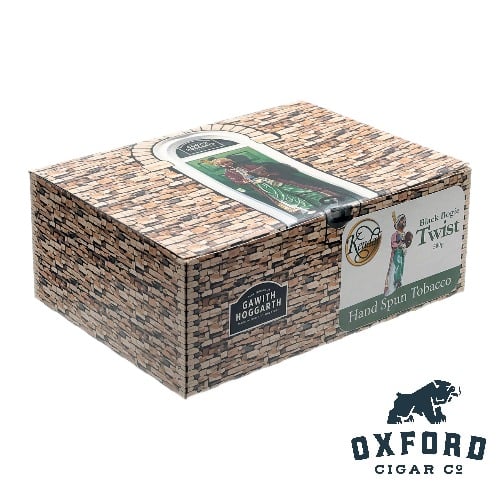
Gawith Hoggarth & Co. Black Bogie Twist
Gawith Hoggarth & Co. Black Bogie Twist is a full bodied, extremely strong, hand spun rope tobacco made from dark fired Virginia leaves that are twisted into a rope, then pressed, steamed, and baked (stoved) until they turn jet black. It is manufactured at the Gawith Hoggarth factory in Kendal, England, on the edge of the Lake District, where the Gawith family has been producing tobacco since 1792. Black Bogie is a multi use tobacco: it can be sliced into coins and smoked in a pipe, or chewed as a traditional twist tobacco. The rope arrives damp (at a moisture level suited for chewing), and pipe smokers should slice coins from the rope and allow them to dry before loading a bowl. When dried and smoked with patience, Black Bogie delivers a dark, smoky, meaty, intensely flavored experience unlike anything in the modern pipe tobacco market. The GH catalogue describes it plainly: “Traditional full bodied tobacco, hand spun into rope form. Can be enjoyed either as a chewing tobacco or pared with a knife for the pipe. A full flavoured, cool smoke.” Pastor Padron from the Twins Pipe Club described the flavor as “deep, rich, and beefy with a finish that reminds me of Yorkshire pudding.” This is not a tobacco for beginners. It is a tobacco for experienced pipe smokers who want to experience the leading edge of strong, dark, intensely flavored tobacco.
- Dark fired Virginia leaves, hand spun into a rope and then pressed, steamed, and baked (stoved) to produce the signature jet black color and deep, smoky, meaty flavor.
- Black Bogie is cooked longer than Brown Bogie, which paradoxically makes the tobacco milder in nicotine than its brown counterpart while intensifying the smoky, dark aroma.
- Rope cut (approximately 15mm diameter), hand spun in the traditional English method at the Gawith Hoggarth factory in Kendal, England.
- Multi use tobacco: slice coins for the pipe, chew it straight from the rope, or (for the adventurous) grind it into snuff. The moisture level arrives suitable for chewing.
- Extremely strong nicotine content. Multiple reviewers describe it as “heavyweight” and recommend experienced smokers only. A small bowl in a small pipe is the wise approach.
- Full taste with no artificial flavoring. The flavor comes entirely from the dark fired Virginia leaf and the stoving process.
- Made by Gawith Hoggarth & Co., the only remaining tobacco manufacturer in England, operating in Kendal since 1792 and now run by Rachel Gawith, a direct descendant of the original founder, representing the 7th generation of the family.
- Unscented version. GH also produces scented Black Bogie variants (aromatic), but this is the pure, unscented expression of the tobacco.
Preparing Black Bogie for the pipe
Black Bogie arrives at a moisture level designed for chewing, which means it is far too wet to smoke straight from the package. Pipe smokers need to slice coins from the rope using a sharp knife, then allow those coins to air dry for several hours or overnight. The rope slices easily despite its density, producing slightly squared coins that are jet black and shiny. Once dried, the coins can be gently ruffled apart and loaded into the bowl without fully rubbing them out. A gentle technique when loading preserves the tobacco’s structure and helps it burn slowly and evenly.
One TobaccoReviews reviewer offered practical wisdom: “Purists will say that one should smoke this as it comes and not attempt to dry it, otherwise it will burn fast and you will lose nuance and flavour. This overlooks that historically, users of this tobacco would not have been jarring it up in airtight containers. It would likely have been wrapped in a cloth or carried around in a simple pouch. It would have dried as a matter of course.” The most experienced Black Bogie smokers recommend a small bowl in a meerschaum pipe. The dark fired tobacco’s oils and intensity can ghost a briar, leaving a persistent flavor that may affect future bowls of lighter tobaccos. Meerschaum does not ghost, making it the ideal vessel for a tobacco this powerful.
What it tastes like
Black Bogie is not a subtle tobacco. The flavor profile is dark, smoky, meaty, and intensely earthy. Multiple reviewers independently reach for the same descriptor: beef. The smoke tastes of grilled meat, charred steak rind, and a deep umami savoriness that is unlike any other tobacco category. Underneath the meatiness sits a dark, tarry smokiness from the dark fired Virginia and the stoving process, a quality that one reviewer compared to Lapsang Souchong tea. The smoke has a creamy mouthfeel despite its power, and touches of liquorice, hay, and a faint sweetness appear if the tobacco is sipped slowly and patiently.
Speed matters. If Black Bogie is puffed aggressively, it turns acrid and one dimensional. If it is sipped slowly, complexity emerges: the smoky, meaty character develops grassy and hay like undertones, and what one reviewer called “little tinges” of sweetness surface from the Virginia underneath the dark fired processing. Pastor Padron’s “Yorkshire pudding” description captures the overall impression: savory, beefy, rich, and deeply satisfying in the way that only a traditional English comfort food can be. The room note is strong and not universally loved, falling into the tolerable to strong range. The aftertaste lingers for a long time.
Black Bogie vs Brown Bogie
Gawith Hoggarth produces both Black Bogie and Brown Bogie from the same base: dark fired Virginia leaves hand spun into rope. The difference is the cooking time. Black Bogie is stoved longer, which deepens the color to jet black, intensifies the smoky aroma, and (counterintuitively) reduces the nicotine content relative to Brown Bogie. Brown Bogie retains more of the raw dark fired Virginia’s natural nicotine punch because the shorter cooking time leaves more of the original compounds intact. Both are extremely strong by any reasonable standard, but Brown Bogie is the heavier of the two in terms of nicotine delivery. Black Bogie compensates with a more intensely flavored, smokier, darker taste profile.
The stoving process
Stoving is a heat treatment process that transforms tobacco’s color, flavor, and chemical composition. After the dark fired Virginia leaves are hand spun into rope, Black Bogie is pressed, steamed, and baked in ovens for an extended period. The heat caramelizes natural sugars in the Virginia leaf, breaks down certain compounds, and produces the jet black color and deep, smoky, almost coal like aroma that defines the tobacco. One experienced reviewer noted “a coal like aroma to all of the black ropes and twists from GH,” speculating about the specific heat source used in the stoving. Whatever the exact method, the result is a tobacco that bears almost no resemblance to the stoved Virginias found in other brands. There are no citrus or dried fruit notes. The stoving of dark fired Virginia at this intensity produces something primal: dark, tarry, smoky, and meaty.
Gawith Hoggarth & Co.
The Gawith family has been manufacturing tobacco since 1792 when the grandfather of Samuel Gawith established a tobacco and snuff business in Kendal, a market town on the edge of England’s Lake District. Originally, tobacco leaves were ground into snuff using a water powered mill just outside of Kendal, then carried back to a shop in town where it was flavored, packed, and sold. Around 1830, the tobacco factory moved to premises on Lowther Street, still owned by the Gawith family today and known as “The Old Snuff Works.” The company split in 1887 when a new partnership was founded between Samuel Gawith’s youngest brother William Henry and Henry Hoggarth Jr., creating Gawith Hoggarth & Co.
Today, Gawith Hoggarth & Co. is the only remaining tobacco manufacturer in England. The company is run by Rachel Gawith, a direct descendant of the original Kendal snuff and tobacco maker, representing the 7th generation and over 230 years of continuous family ownership. The factory produces pipe tobacco, twist tobacco, chewing tobacco, and snuff using methods and machinery that date back centuries. Black Bogie Twist is one of the company’s most traditional products, a direct link to the English rope tobacco tradition that predates modern pipe tobacco blending by generations.
The English rope tradition
Rope tobacco is one of the oldest forms of processed tobacco in the world. Long before tobacco was cut into ribbons, pressed into flakes, or crumbled into ready rubbed blends, it was twisted into rope. Sailors, soldiers, miners, and laborers carried rope tobacco because it was durable, portable, and versatile: a length of rope could be chewed during work, sliced for a pipe during rest, or even ground into snuff. The rope format preserved the tobacco naturally, with the tightly spun leaves resisting drying and deterioration far better than loose cut tobacco. Gawith Hoggarth is one of the last companies in the world still producing hand spun rope tobacco using traditional methods, and Black Bogie represents the darkest, most intensely processed expression of that tradition.
Nicotine warning
Black Bogie is rated “extremely strong” on TobaccoReviews by multiple reviewers. This is not marketing hyperbole. The dark fired Virginia base carries significantly more nicotine than standard Virginia or Burley tobaccos, and the rope format concentrates the tobacco densely. Even experienced pipe smokers who regularly handle strong tobaccos like Irish Flake or dark fired Kentucky blends should approach Black Bogie with respect. One reviewer recommended building up to it through a progression: strong flakes first, then plugs, then brown ropes, and only then attempting the black ropes. A small bowl, slow sipping, and a full stomach are standard precautions. As one TobaccoReviews reviewer put it: “Watch out for the nicotine. It will sneak up on you.”
Pairings
Black Bogie’s dark, meaty, smoky intensity demands pairings that can stand alongside it. A strong black coffee, preferably a French press or Turkish brew, matches the tobacco’s weight and adds its own dark, bitter complexity. Espresso is an ideal companion. For tea, Lapsang Souchong creates a unified smoky experience, while a strong builder’s tea with milk and sugar provides a softening counterpoint. Scotch whisky, particularly a peated Islay single malt, shares Black Bogie’s smoky, tarry, primal character. A full bodied stout or imperial porter matches the tobacco’s meatiness and dark intensity. For food, strong cheddar cheese, cured meats, or a slice of Yorkshire pudding (as Pastor Padron suggested) all complement the beefy, savory quality that defines this tobacco.
| Brand | Gawith Hoggarth & Co. |
|---|---|
| Product | Black Bogie Twist (Unscented) |
| Blend Type | Straight Virginia (dark fired) |
| Contents | Dark fired Virginia |
| Process | Hand spun, pressed, steamed, and baked (stoved) |
| Cut | Rope (approximately 15mm diameter) |
| Country | United Kingdom (Kendal, England) |
| Strength | Extremely strong |
| Taste | Full to very full |
| Flavoring | None (unscented) |
| Room Note | Tolerable to strong |
| Packaging | Bulk |
| Use | Pipe tobacco or chewing tobacco |
| Core Flavor Elements | Grilled beef, charred meat, smoke, tar, liquorice, hay, umami, dark earthiness, creamy mouthfeel, Yorkshire pudding finish, faint sweetness, coal like aroma |
Quick specs
- Blend Type: Straight Virginia (dark fired)
- Cut: Rope (hand spun)
- Strength: Extremely strong
- Taste: Full to very full
- Origin: Kendal, England
- Use: Pipe or chewing
What is Black Bogie Twist?
It is a full bodied, extremely strong rope tobacco made from dark fired Virginia leaves that are hand spun into rope, then pressed, steamed, and baked (stoved) until jet black. Made by Gawith Hoggarth & Co. in Kendal, England. It can be sliced for the pipe or chewed straight from the rope.
What does Black Bogie taste like?
Dark, smoky, meaty, and intensely earthy. Reviewers consistently describe flavors of grilled beef, charred steak rind, and umami savoriness, with underlying notes of liquorice, hay, tar, and faint sweetness. Pastor Padron described it as “deep, rich, and beefy with a finish that reminds me of Yorkshire pudding.” Creamy mouthfeel despite its power.
How do I prepare Black Bogie for a pipe?
Slice coins from the rope with a sharp knife, then air dry for several hours or overnight. The tobacco arrives at chewing moisture, too wet to smoke straight from the package. Once dried, gently ruffle the coins apart and load into a small bowl. Sip slowly. A meerschaum pipe is recommended to avoid ghosting a briar.
How strong is Black Bogie?
Extremely strong. Multiple TobaccoReviews reviewers rate it at the highest end of nicotine strength. Experienced smokers recommend building up through strong flakes, plugs, and brown ropes before attempting black rope tobacco. Small bowls and slow sipping are essential.
What is the difference between Black Bogie and Brown Bogie?
Both use dark fired Virginia leaves hand spun into rope. Black Bogie is stoved longer, making it darker in color, smokier in aroma, and (counterintuitively) slightly milder in nicotine than Brown Bogie. Brown Bogie retains more raw nicotine punch from the shorter cooking time. Both are extremely strong.
Can Black Bogie be chewed?
Yes. Black Bogie is a multi use tobacco designed for both pipe smoking and chewing. The rope arrives at a moisture level suitable for chewing straight from the package. The GH catalogue states it “can be enjoyed either as a chewing tobacco or pared with a knife for the pipe.”
Who makes Black Bogie?
Gawith Hoggarth & Co., the only remaining tobacco manufacturer in England. The company has been producing tobacco in Kendal since 1792 and is now run by Rachel Gawith, 7th generation descendant of the original founder. The factory sits on the edge of the Lake District, a UNESCO World Heritage Site.
What pairs well with Black Bogie?
Strong black coffee, espresso, Lapsang Souchong tea, peated Islay Scotch whisky, imperial stout, full bodied porter, strong cheddar cheese, cured meats, and Yorkshire pudding all complement the tobacco’s dark, smoky, meaty, intensely flavorful character.
| Selection | 500g |
|---|
Share your thoughts!
Let us know what you think...
Only logged in customers who have purchased this product may leave a review. Log in now

What others are saying
There are no contributions yet.