
Kopp Limited Edition: Flame 1919 (2024)
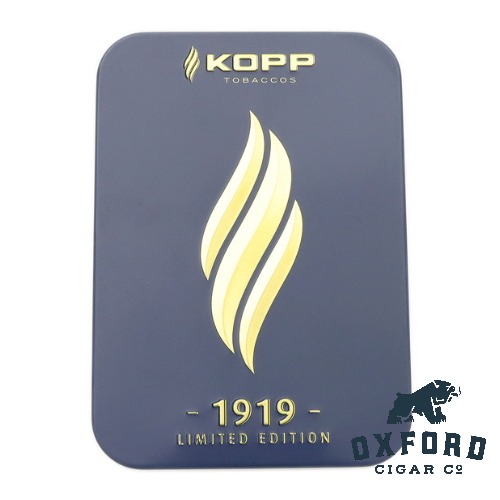
Kopp Limited Edition Flame 1919 (2024) is a medium strength, Virginia based small batch blend of cube cut Virginias, cube cut Burleys, Black Cavendish, and Perique, blended in Germany by Kohlhase, Kopp und Co. KG. The “1919” in the name honors the founding year of Martin Wess, the leather goods company that eventually became the Kopp tobacco empire. “Flame” refers to the fire motif on the tin’s artwork. The blend arrives in a mixed cut format: some pieces are lightly rubbed out flakes, some are large cube cuts, and a few ribbons connect them. This is not a uniform cut, and that irregularity is part of the design. The different cuts burn at different rates, creating waves of flavor that shift between the creamy Black Cavendish, the woody Burley, the grassy Virginias, and the occasional spicy punch from the Perique. Pastor Padron (Not Just Blowing Smoke) named it one of his Best of 2024 and described it as “deep, sweet, and creamy, with notes of stewed fruit, dark chocolate, nuts, and rye bread.” Sir Otter on TobaccoReviews called it “a luxurious treat” and wrote: “Flame 1919 is not a modern blend, this is a heavy smoke, your great great granddad’s smoke.” Available in 100g tins.
- Cube cut Virginias provide the blend’s foundation: grassy, tangy, and naturally sweet with dark fruit (figs, raisins, prunes) and a fermented character that deepens as the bowl progresses.
- Cube cut Burleys add a toasty, woody, slightly cocoa like quality that grounds the blend and prevents the Virginias from becoming too sweet or one dimensional.
- Black Cavendish contributes creaminess, volume of smoke, and a smoothing effect that rounds out the bolder Virginia and Burley components without adding detectable artificial flavoring.
- Perique brings spice and a picante quality that arrives in occasional bursts rather than a constant presence, adding complexity and a throat hit that interacts with the Burley’s toastiness.
- Mixed cut format: cube cuts, lightly rubbed out flakes, and ribbons combined in a single blend. The different cuts create shifting flavor waves as the bowl progresses.
- Medium strength (TobaccoReviews consensus), medium to full taste, tolerable to pleasant room note. No added flavoring detected.
- Named for 1919, the founding year of Martin Wess, the leather goods company started by Martin Wess that became the foundation of the Kopp family business empire.
- Blended in Germany by Kohlhase, Kopp und Co. KG. Available in 100g tins. Packaging note: the tin does not have an airtight seal. The tobacco is packed in a plastic bag inside the tin. Transfer to an airtight container or mason jar for storage and aging.
What it tastes like
The tin note is striking: prunes, dark tobacco, raisins, bread, and a fermented sweetness that signals what is coming. Pastor Padron’s description captures the core profile accurately: stewed fruit, dark chocolate, nuts, and rye bread, with warm cedar on the retrohale and a finish of stewed fruits and molasses. The body is medium to full and the strength is medium.
The opening draws bring the Virginias forward. A grassy, tangy quality leads, and dark sweet fruit (figs, raisins, prunes) emerges from the fermented Virginia leaf. One YouTube reviewer compared the initial impression to Samuel Gawith Full Virginia Flake, noting a similar oily, fermented Virginia character. The Burleys arrive with a toasty, slightly cocoa inflected quality that one TobaccoReviews reviewer described as “slightly woody whilst offering some cocoa.” The Black Cavendish smooths everything together with a creamy, rounded mouthfeel that adds volume and body without a detectable topping.
As the bowl progresses, the complexity deepens. The mixed cut format means different pieces ignite and burn at different rates, creating waves where the Virginia’s dark fruit surges forward, recedes, and then the Burley’s toasty woodiness takes over. The Perique does not dominate. Sir Otter called it “especially picante,” and it arrives in bursts rather than a constant stream, adding a spicy throat hit that interacts with the Burley’s nuttiness. One reviewer noted that “just when you’re kind of going this is getting a little bit mundane all of a sudden you’ll get like a hit of those pruny fermented Virginias come in,” followed by “that Perique and Burly thing going on where you get more of a throat hit.” The back and forth between these four tobaccos is what makes Flame 1919 engaging rather than flat.
The finish is warm and lingering. Stewed fruits, molasses, and rye bread persist on the palate, and the cedar that Pastor Padron noted on the retrohale provides a clean, woody frame around the darker, sweeter elements. The room note falls in the tolerable to pleasant range. The tobacco burns cool, does not bite, and delivers solid medium to medium plus intensity with genuine complexity.
The mixed cut
Flame 1919 does not look like a typical tin of pipe tobacco. Instead of a uniform ribbon or a stack of identical flakes, the blend contains a mix of cube cuts, lightly rubbed out flakes (some darker, some lighter), and ribbons. The Facebook review from United Pipe Clubs described it as “complex both in cut and flavor,” noting that the different cuts contribute to the blend’s layered character. The lighter cube cuts are likely the Virginias and Burleys, the darker flake pieces are the more heavily processed Virginias, and the black specks are the Perique and Black Cavendish. This irregularity means the bowl does not burn in a perfectly uniform way. Different pieces reach their optimal temperature at different times, which is why flavors shift and surge rather than presenting a single, static profile.
The Kopp story
The Kopp family business began in 1919 when Martin Wess started a leather goods company in Germany. The business grew to nearly 100 employees and even opened a sales office on New York’s 5th Avenue. Martin’s grandchildren, Gottfried and Frederike, along with Frederike’s husband Friedrich Kopp, joined the company. After Frederike handed management to her 14 year old son Bernd Kopp in 1954, the business transformed. Bernd shifted production from leather travel cases to pipe pouches and tobacco accessories under the Martin Wess brand, creating some of the finest pipe leather goods in the world.
In 1971, Bernd Kopp founded Otto & Kopp with Lothar Otto, an import company that brought renowned pipe brands (Ascorti, Caminetto, Nørding) into the German market. The acquisition of 80% of Kohlhase & Bühler in 1979 brought pipe tobacco brands Robert McConnell and Rattray’s into the portfolio, transforming the company from a pipe importer into a full spectrum tobacco business. After Lothar Otto’s death in 2009, Bernd consolidated ownership. In 2019, his son Oliver Kopp became managing director, and since 2023 Oliver and his brother Thilo have been sole owners of Kopp Tobaccos. The commissioning of the company’s own flake presses marked a step toward production independence from larger manufacturers. What started as a leather goods workshop in 1919 has grown into a family owned business group with 85 employees, now over 100 years old and producing limited edition pipe tobaccos under its own name.
A note on storage
Pastor Padron raised an important practical concern: the tin does not have an airtight seal. The tobacco arrives packed in a plastic bag inside the tin. As a tobacconist, he expressed concern about shelf life and recommended transferring the tobacco to an airtight container. This is especially important if you plan to age Flame 1919. Mason jars work well for long term storage. If you open the bag and leave it in the unsealed tin, the tobacco will dry out. The blend’s moisture level out of the bag is good and does not require drying before smoking.
Pairings
Flame 1919’s stewed fruit, dark chocolate, rye bread, and toasty character pairs naturally with a German style dark rye bread and strong cheese for a food pairing that echoes the tobacco’s own bready, nutty flavors. A medium to dark roast coffee with chocolate and nutty tones mirrors the Burley’s cocoa and the Virginia’s dark fruit. Espresso pulls out the molasses and stewed fruit notes. For spirits, a German wheat beer or Märzen matches the bread and toasty qualities, while a tawny port shares the tobacco’s stewed fruit, dried fig, and molasses character. An amaro or Fernet Branca provides a bitter, herbal counterpoint that cuts through the Cavendish’s creaminess. For tea, a strong Assam with milk and sugar complements the full bodied, dark, warming character of the blend.
| Brand | Kohlhase, Kopp und Co. KG |
|---|---|
| Product | Flame 1919 (2024) Limited Edition |
| Blend Type | Virginia based |
| Components | Virginia, Burley, Black Cavendish, Perique |
| Cut | Mixed (cube cut, rubbed out flake, ribbon) |
| Country | Germany |
| Manufactured By | Kohlhase & Kopp |
| Strength | Medium |
| Taste | Medium to full |
| Flavoring | None detected |
| Room Note | Tolerable to pleasant |
| Packaging | 100g tin (non airtight, tobacco in plastic bag inside) |
| Core Flavor Elements | Stewed fruit, dark chocolate, nuts, rye bread, prunes, figs, raisins, molasses, cocoa, cedar, toasty woodiness, grassy Virginia, picante Perique spice, cream |
Quick specs
- Blend Type: Virginia based
- Components: Virginia, Burley, Black Cavendish, Perique
- Cut: Mixed (cube cut, flake, ribbon)
- Strength: Medium
- Taste: Medium to full
- Tin Size: 100g
What is Kopp Flame 1919?
It is a limited edition, Virginia based pipe tobacco blended from cube cut Virginias, cube cut Burleys, Black Cavendish, and Perique. Blended in Germany by Kohlhase, Kopp und Co. KG. The “1919” honors the founding year of Martin Wess, the company that became the Kopp tobacco empire. Available in 100g tins.
What does Flame 1919 taste like?
Deep, sweet, and creamy. Stewed fruit, dark chocolate, nuts, rye bread, molasses, and warm cedar on the retrohale. The Burleys add toasty, cocoa like woodiness. The Perique brings picante spice in occasional bursts. Medium strength, medium to full body. Pastor Padron named it one of his Best of 2024.
What is the cut?
A mixed cut of cube cut pieces, lightly rubbed out flakes, and ribbons. The different cuts burn at different rates, creating shifting waves of flavor as the bowl progresses. One reviewer called it “complex both in cut and flavor.”
Does it need to be dried before smoking?
No. The moisture level out of the bag is good for smoking. The tobacco does not need drying time before loading.
How should I store Flame 1919?
Transfer to an airtight container or mason jar. The tin does not have an airtight seal. The tobacco arrives in a plastic bag inside the tin. If left in the unsealed tin, the tobacco will dry out. This is especially important if you plan to age the tobacco.
Who makes Kopp pipe tobacco?
Kohlhase, Kopp und Co. KG, a German family owned business with roots dating to 1919. Now run by Oliver and Thilo Kopp, third and fourth generation descendants. The company also owns Robert McConnell and Rattray’s pipe tobacco brands. Over 100 years of continuous family ownership with 85 employees.
Is Flame 1919 an aromatic?
TobaccoReviews lists no detected flavoring, and Pastor Padron’s review does not mention any topping. The sweetness comes from the natural Virginia sugars and the Black Cavendish’s processing. One TobaccoReviews reviewer categorized it as a “light aromatic,” while another described it as a straight, unflavored Virginia based blend. The consensus leans toward natural, unflavored tobacco with aromatic like sweetness from the leaf itself.
What pairs well with Flame 1919?
Medium to dark roast coffee, espresso, German wheat beer, Märzen, tawny port, amaro, Fernet Branca, strong Assam tea with milk and sugar, dark rye bread, and strong cheese all complement the blend’s stewed fruit, dark chocolate, rye bread, and toasty character.
| Selection | 100g Tin |
|---|
Share your thoughts!
Let us know what you think...
Only logged in customers who have purchased this product may leave a review. Log in now
Related products


What others are saying
There are no contributions yet.