


News
Bourbon and Cigars in Winter: Pair by Intensity, Not by the Name on the Barrel
Bourbon and Cigars in Winter: Pair by Intensity, Not by the Name on the Barrel
A method for pairing a whiskey with a cigar when the weather turns, and the one cigar on our shelf that teaches it best.
Winter is the season the pairing makes sense in. Not because anything changes in the glass or the humidor, but because the smoke gets longer. A ninety-minute cigar in July is an endurance test; in January it is the evening. And a bourbon — unhurried, sweet at the front, warm at the back — is the pour that keeps pace with it. The question is not whether to pair the two. It is how to choose which bourbon and which cigar, and most of the advice in circulation answers that question badly.
The mistake: matching the label
Matching a cigar’s cask to a spirit can be a starting point, but it does not settle the pairing. Compare the body, sweetness and finish of the two. Decide whether you prefer similar flavours or a contrast rather than treating the cask name as a rule.
We make the point on the barrel-aged cigars guide, and it is worth repeating here because it governs everything below: the cask tells you what the cigar tastes of. It does not tell you what to drink. What tells you what to drink is intensity.
Three questions, in this order
How heavy is the cigar? Body first, before flavour, before anything. A medium-bodied cigar against a barrel-proof bourbon is not a pairing; it is a cigar being erased. Match weight to weight and you have a conversation. Mismatch it and the louder party simply wins.
How sweet is the pour, and at what proof? Start with a bourbon you know and a proof you find comfortable. Compare its sweetness and intensity with the cigar; if one overwhelms the other for you, try a different pairing. Treat wheated and high-rye styles as options to compare, not guarantees of a particular result.
Where does each one finish? This is the question nobody asks and the one that decides whether a pairing is memorable. A cigar that finishes long and dry wants a spirit that lingers with it. A short, clean finish on the whiskey against a cigar that holds for a minute leaves a gap, and you spend the gap waiting instead of tasting. Sip on the cigar’s finish, not during the draw.
Order matters in the glass too. Take the first sip to acclimatise — the alcohol will dominate whatever it meets — and judge the pairing on the second.
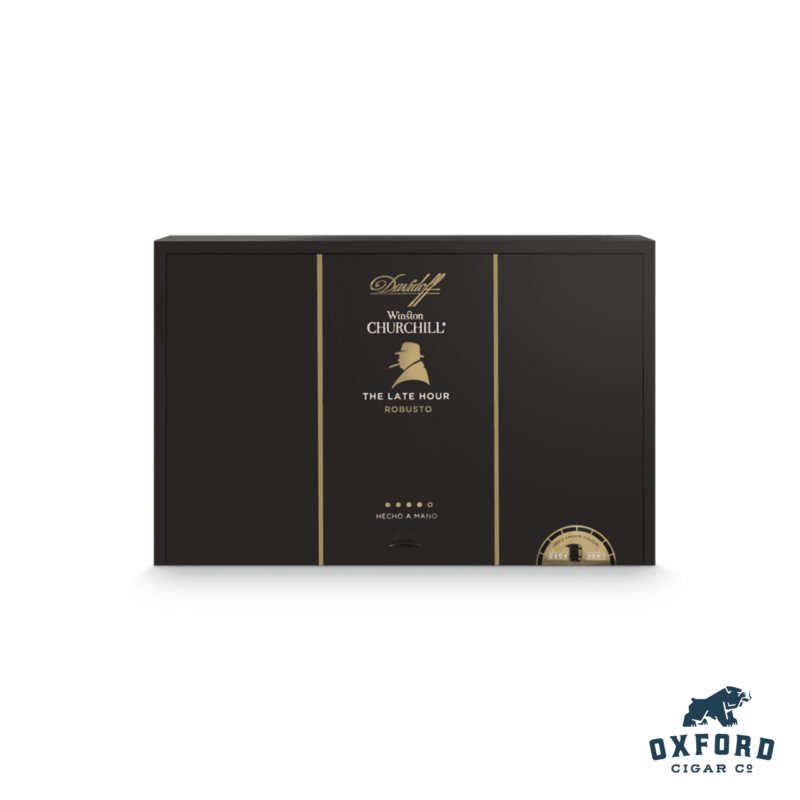
The cigar: Davidoff Winston Churchill The Late Hour, Robusto 5 x 52
If you want one cigar to learn this on, take The Late Hour — and take it in the Robusto.
Davidoff identifies The Late Hour’s cask-aged tobacco as Nicaraguan Condega Visus, aged for six months in Scotch single-malt whisky casks. The blend has an Ecuadorian Habano Oscuro wrapper and a Mexican binder. Its Scotch-cask component does not require you to choose Scotch as the accompanying drink.
Davidoff describes The Late Hour as full-bodied. For a comparison with bourbon, taste each separately and then together, noting whether the body, sweetness and finish suit your preferences. Treat flavour notes and their timing as observations to make, rather than a promised sequence.
The Robusto at 5 x 52 is the format for it. The ring gauge carries the blend at its proper weight, and it runs to about an hour — long enough for the cask to show itself and for that dry finish to do its work, short enough that you are still tasting carefully at the end. The Toro at 6 x 54 is the same blend over a longer evening; the extra length draws the progression out rather than changing it.
If you smoke a pipe instead
The same technique travels, and in pipe tobacco the cask is often genuinely bourbon. Seattle Pipe Club’s Plum Pudding Bourbon Barrel Aged is the one to know — Joe Lankford’s Balkan blend of Cyprian Latakia, Turkish Orientals, Virginias, Cavendish and Perique, rested thirty days in charred Kentucky bourbon casks and pressed into a crumble cake, with a chunk of the barrel oak left in the tin. The ageing pushes it richer and sweeter: dark chocolate, espresso, dried spiced fruit, caramel and vanilla over the smoky Latakia base.
Apply the method and the answer changes, which is the point of having a method. The tin is mild to medium in strength, not full — so the bourbon that suited The Late Hour would walk straight over it. Drop the proof, keep the sweetness, and let the pour sit under the smoke rather than beside it.
Check the full product name and the stated cask before choosing a barrel-aged tobacco. Do not assume that every barrel-aged blend uses bourbon casks. Compare the blend and your own preferences when choosing an accompanying drink.
The last word
Pairing is not a lookup table. It is three judgements — weight, proof, finish — made in order, and the cask on the label is evidence for none of them. Learn it on one cigar and one bottle before you learn it on ten. And if the pairing is for a cold evening and ninety minutes is more than you have, our note on short cigars for cold weather covers the shorter end of the humidor.
About Oxford Tobacconist: Oxford Tobacconist is Oxford Cigar Company’s editorial byline for cigar news, product information, and guides. Oxford Cigar Company sells products linked in this guide.
